

Social responsibility

The Otto Group is part of society. Our actions have an impact on our own employees, the people in our supply chains, the organizations we cooperate with, and last but not least, on our customers. Therefore, we bear responsibility on many levels, which we fulfill as a reliable partner and promoter of diverse initiatives. Through our value-oriented approach, we aim to positively shape the future of our society.
Stories on social responsibility


Social responsibility in detail
Human rights
The people we work and interact with should feel safe and treated fairly. This applies to our own employees, our business partners, to workers along our supply chains, our service providers, and of course, our customers. People are always at the center of our actions. In our Human Rights Declaration, we have defined our commitment to human rights in our companies and the value chain. It expresses our values and our attitude.
Working conditions
Safe and fair working conditions along our supply chains and for our own employees are our goal. This includes compliance with social standards and regulations regarding environmental protection and occupational safety, which are outlined in a Code of Conduct. The Otto Group offers training measures and workshops in the supply chains to further advance topics such as fair wages, occupational safety, and child-free production. Every year, we report on our progress in our Annual Report and regularly check whether our measures are effective or need to be adjusted.
Foundations / commitment
The history of the Otto Group is closely linked to its social and environmental commitment. We believe that with economic success comes the responsibility to help others, support them on their journey, and advance society as a whole – an approach we have pursued for decades.
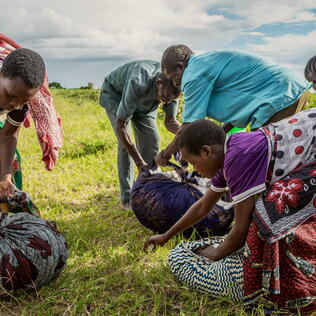
The Environmental Foundation Michael Otto (Umweltstiftung Michael Otto) has been addressing the question of what forward-looking solutions for nature conservation and environmental protection can look like for over 30 years and helps implement them. The Aid by Trade Foundation, founded by Prof. Dr. Michael Otto in 2005, is the bearer of the standards “Cotton made in Africa” (CmiA) and “The Good Cashmere”. The CmiA initiative advocates for controlled environmental protection and better living and working conditions for smallholder cotton farmers in Sub-Saharan Africa. “The Good Cashmere” promotes sustainably produced cashmere from Inner Mongolia, considering animal wellfare, social criteria, and ecological sustainability. In 2012, at the initiative of Prof. Dr. Michael Otto, the Stiftung KlimaWirtschaft (formerly Stiftung 2°) was founded. It unites well-known business leaders committed to ambitious climate protection.
The Otto Group is also actively involved in supporting youth and children. The Hamburg training network HANZ, co-initiated by Prof. Dr. Michael Otto in 2000, is a network of numerous companies that has been working for over 20 years to create equal opportunities for disadvantaged young people and provide them with a fair chance at solid employment through support and placement services. The foundation acts as an interface between the home, school and the workplace. Since 2008, we have been inspiring children and young people for music with the initiative The Young ClassX, reaching approximately 30,000 students so far. Through the Finlit Foundation, we raise awareness among children about the proper handling of money and finances.
In May 2024, Prof. Dr. Michael Otto expanded his diverse, long-standing social commitment with the establishment of the Michael Otto Foundation for Sustainability. This new foundation will focus on preserving biodiversity and promoting democracy and human rights worldwide.